


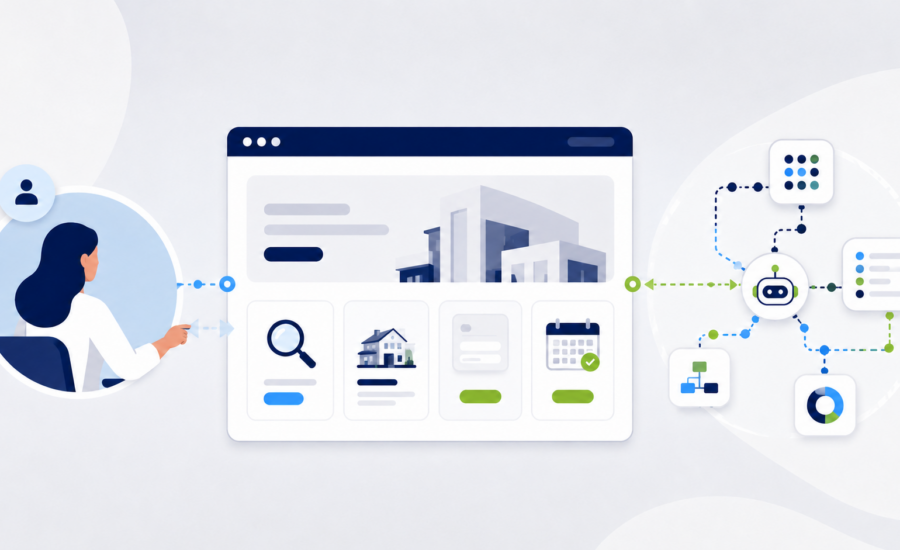
For most of the web’s history, websites have been designed primarily for people.
A visitor arrives, reads the content, navigates through menus, completes a form, searches for a product or works through a checkout process. Search engines may index the information, but the important actions are still designed around a person clicking, typing and making decisions on the page.
AI agents are beginning to change that relationship.
Instead of only helping someone find a website, an AI agent may increasingly help them use it. It could search a product catalogue, compare suitable options, complete parts of an enquiry, find an available appointment or prepare a purchase for the customer to review.
That raises a practical question for businesses:
If AI agents are going to use websites differently, what makes a website agent-ready?
An agent-ready website is still a website for people
An agent-ready website is not a replacement for your existing website, nor should it be a separate, stripped-down interface built for machines at the expense of human visitors.
We have been through a version of that thinking before. I remember the early days of the mobile web, when some businesses created separate .mobi websites for mobile visitors. Over time, responsive design became the more practical approach: one website that could adapt to different devices without maintaining an entirely separate mobile presence.
Agent readiness should follow a similar principle. The objective is not to create one website for people and another for AI agents. It is to build a strong human-facing website that can also communicate its information, capabilities and boundaries clearly to authorised agents.
The distinction matters.
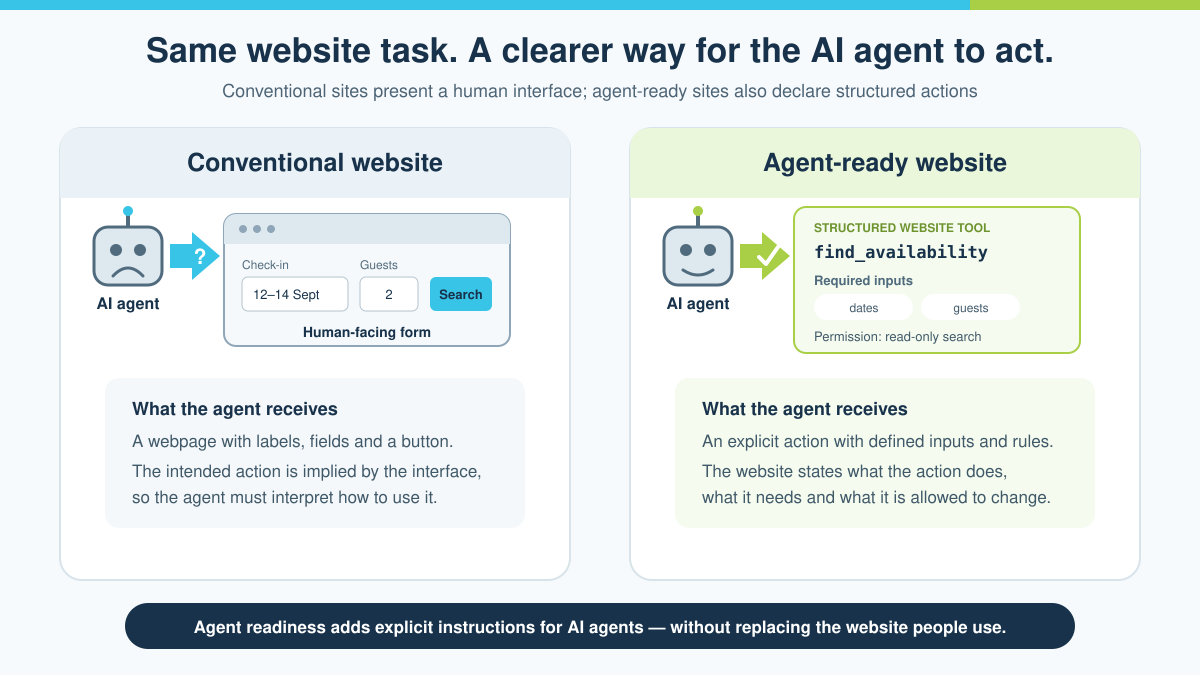
AI agents can already attempt to operate ordinary websites by reading pages, interpreting interface elements and simulating clicks and keyboard input. However, this leaves the agent to work out what each field, button and step is intended to do.
That may be manageable when the task is simple. It becomes less reliable when the website contains complex forms, product filters, booking rules, account information or multi-step transactions.
An agent-ready website reduces some of that guesswork.
It does not merely present an interface and hope the agent interprets it correctly. It can explicitly describe the actions available, the information required and the result that should be expected.
What could an AI agent actually do on a website?
The useful answer is not “everything.”
A business should decide which actions genuinely help its customers and which actions should remain restricted, confirmed or entirely human-controlled.
Depending on the website, suitable actions could include:
- Searching products using specific requirements.
- Filtering properties, services or accommodation.
- Finding available booking dates.
- Starting an enquiry with correctly structured information.
- Locating the right support process.
- Retrieving appropriate product or service information.
- Adding selected items to a wishlist or cart.
- Preparing an application or purchase for the customer to review.
- Checking an order status after appropriate authentication.
Consider a customer looking for accommodation for particular dates, within a set budget and with specific facilities.
A conventional agent may need to open the website, locate the booking interface, interpret the date picker, apply several filters and read the resulting pages. At every step, it must infer how the interface works.
An agent-ready website could instead provide a defined action such as:
Find available accommodation for these dates, for this number of guests, within this price range and with these facilities.
The website still controls the availability data, pricing rules and result. The agent is simply given a clearer and more reliable route through the process.
The four practical layers of an agent-ready website
“Agent-ready” should not be reduced to one plugin, protocol or line of code. It involves several connected layers.
1. Information that agents can understand
The foundation remains a well-built website with accurate, accessible and clearly organised information.
This includes:
- Clear descriptions of products and services.
- Logical page and heading structures.
- Meaningful labels and navigation.
- Accurate business and contact information.
- Semantic HTML.
- Appropriate structured data.
- Consistent product, pricing and availability information.
Many of these practices already support accessibility, usability and search visibility. Agent readiness builds on them rather than replacing them.
If a website’s information is outdated, contradictory or poorly structured, giving an agent access to it will not solve the underlying problem. It may simply allow the confusion to travel faster.
2. Actions that agents can discover
The next layer is making useful website capabilities explicitly available to agents.
One emerging approach is WebMCP, or Web Model Context Protocol. It is a proposed web standard that allows a website to expose predefined tools to AI agents.
A tool could represent an action such as:
- search_products
- filter_results
- find_availability
- start_enquiry
- add_to_wishlist
Each tool can describe what it does, when it should be used and what information it requires.
This is different from an agent merely examining a page and deciding that a particular button probably performs the action it needs. The website itself defines the capability.
Chrome’s WebMCP documentation describes this as a way for websites to expose structured tools through JavaScript or annotated HTML forms. The technology is still experimental and under active development, but it has already moved beyond being only a theoretical idea.
OpenAI has also introduced its own implementation, called Site tools. In supported versions of the ChatGPT desktop app, ChatGPT Work and Codex can discover tools offered by the website currently open in the built-in browser.
That is an important development, but it does not mean WebMCP is already universally supported or that every business needs to implement it immediately.
3. Reliable execution paths
A useful website tool needs more than a clever name.
It should clearly define:
- What information the agent must provide.
- Which inputs are required.
- What validation rules apply.
- What the website will do.
- What result will be returned.
- Whether the action changes any information or creates a transaction.
- When the user must become involved.
This makes an agent-assisted interaction more predictable.
For example, “submit an application” and “start an application” are not the same action. The first could create a consequential submission. The second might only populate a form for the user to review.
That distinction must be obvious to the agent and the customer.
Reliability also depends on the underlying website. An agent-friendly action cannot compensate for broken integrations, inaccurate stock data, unreliable booking rules or a checkout process that regularly fails.
Agent readiness therefore includes the less glamorous work of maintaining sound website infrastructure and dependable business processes.
4. Security and human control
Giving agents easier access to website actions also creates new risks.
An agent should not be trusted with unlimited authority simply because it can communicate with the website more efficiently.
Appropriate controls may include:
- User authentication.
- Restricted permissions.
- Server-side validation.
- Confirmation before consequential actions.
- Protection against replay or duplicate submissions.
- Clear separation between read-only and write actions.
- Logging and audit records.
- Rate limiting and abuse protection.
- Careful treatment of customer and externally supplied content.
Current WebMCP security guidance recognises risks such as indirect prompt injection and recommends distinguishing read-only tools from actions that change data or have significant consequences.
Purchases, bookings, financial transactions, account changes and the release of private information require substantially stronger controls than searching public content.
The objective should not be to remove the person from every process. It should be to let an agent assist where useful while keeping the person appropriately informed and in control.
Is this the same as SEO or AI search optimisation?
No, although the areas overlap.
SEO helps search engines discover, understand and rank website content. Work aimed at AI visibility may also help AI-powered search and recommendation systems interpret and reference the business.
Agent readiness goes a step further. It considers whether an AI agent can not only understand or recommend the website, but also help a user perform a task on it.
A website could therefore be:
- Easy for search engines to find but difficult for an agent to operate.
- Well structured for AI discovery but unable to expose useful actions.
- Technically capable of supporting agent actions but poor at explaining why a customer should choose the business.
Businesses still need useful content, clear positioning, good user experience, sound SEO and reliable infrastructure. Agent readiness adds another layer; it does not make those fundamentals obsolete.
Does your business need to act now?
For most small and medium-sized businesses, there is no need to rebuild a website in a panic.
WebMCP remains a proposed standard, browser and platform support is still developing, and customer adoption of agent-assisted website journeys will not happen evenly across every industry.
There is nevertheless a sensible case for preparing early.
The practical starting point is not “install AI.” It is to identify the customer tasks that matter most and examine how clearly and reliably the website currently supports them.
A business can begin by asking:
- What are the main tasks customers come to our website to complete?
- Which of those tasks could benefit from agent assistance?
- Is the information needed for those tasks accurate and properly structured?
- Are our forms, searches, bookings or checkout processes reliable?
- Which actions could safely be assisted, and which require explicit human confirmation?
- Do our existing systems provide dependable data and validation?
- Could agent capabilities be added progressively without damaging the human experience?
This exercise has value even if the business does not implement WebMCP immediately. It often exposes unclear content, unnecessary friction and disconnected processes that are already affecting human customers.
The wider change businesses should watch
Websites have traditionally served two broad purposes: communicating information and allowing people to perform actions.
AI agents may become another participant in that relationship—working on behalf of people to research, compare, prepare and complete appropriate tasks.
That does not mean every website will become fully autonomous. Nor does it mean people will stop visiting websites.
It means businesses may need to think beyond whether their websites can merely be found and viewed.
The next question is whether the website can clearly communicate what it allows an authorised agent to do, provide a reliable way to do it and retain the controls needed to protect the customer and the business.
That is the practical meaning of becoming agent-ready.






[…] different requirement from allowing an AI agent to book or complete an action on your website. Our guide to agent-ready websites explains that […]