


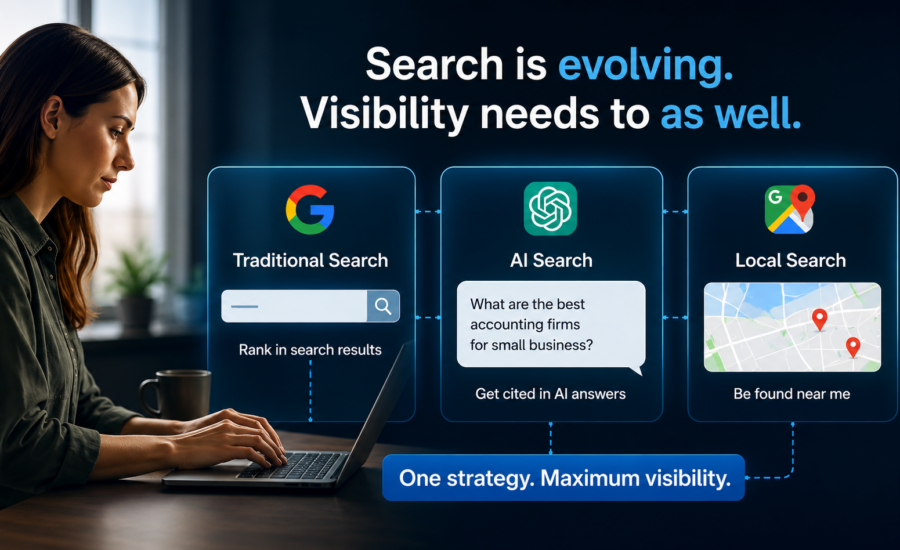
Search has changed – traditional SEO alone is no longer enough
For many years, digital visibility focused almost entirely on ranking websites in Google’s search results.
Businesses invested heavily into keywords, backlinks and on-page SEO in order to secure stronger rankings and increase website traffic.
Those elements are still important today.
However, search behaviour has changed significantly.
Customers no longer rely only on traditional search engines when researching businesses, products or services online.
Today, people also:
- ask AI tools like ChatGPT for recommendations
- use Google AI Overviews to compare options
- search directly on Google Maps
- rely on reviews and local listings
- and consume AI-generated summaries before ever visiting a website
This shift is changing how businesses need to approach online visibility.
Traditional SEO still forms an important foundation, but businesses now need broader visibility across multiple discovery channels.
Google AI Overviews are changing how users interact with search results
Google continues expanding AI-generated search summaries directly within search results, allowing users to receive answers and recommendations before visiting websites. This is changing how businesses think about visibility, structured content and search optimisation.
Source: Google Search Central / Google AI Overviews documentation
Search behaviour is becoming more fragmented
In the past, most customer journeys started and ended on a traditional search engine.
A user would search for a service, browse several websites and compare businesses manually.
That journey now looks very different.
Many users increasingly interact with:
- AI-generated search summaries
- conversational AI platforms
- local search results
- and business profiles directly within Google Maps
Google itself has already introduced AI Overviews into search results, while platforms like ChatGPT and Perplexity are influencing how users discover information online.
This means businesses are no longer competing only for traditional rankings.
They are also competing for visibility within:
- AI-generated answers
- local search results
- and entity-based search experiences.
SEO still matters – but the strategy needs to evolve
There is a common misconception that AI search will completely replace SEO.
That is not accurate.
Technical SEO, quality content, website performance and authority signals still play a major role in how search engines and AI platforms evaluate websites.
In fact, many AI systems rely heavily on trusted web content when generating answers.
What is changing is how content is discovered, interpreted and surfaced.
Modern SEO strategies increasingly need to consider:
- conversational search behaviour
- structured content
- schema markup
- entity optimisation
- local visibility
- and AI-friendly content structures.
This is where AI Search Optimisation and Generative Engine Optimisation are becoming increasingly relevant.
AI Search relies on structured, trustworthy information
AI platforms do not interact with websites in the same way humans do.
Large Language Models (LLM) and AI-driven search systems analyse:
- entities
- relationships
- structured information
- topical authority
- and signals of trustworthiness.
AI platforms are increasingly becoming part of the customer research journey
Platforms such as ChatGPT, Perplexity and Google AI-driven search experiences are changing how users discover and evaluate businesses online. This is increasing the importance of structured, trustworthy and AI-friendly website content.
Source: Adobe Analytics / Similarweb AI search trend reporting
This is one reason why:
- schema markup
- FAQ sections
- author profiles
- business entity consistency
- and well-structured content
have become increasingly important.
Content that is clear, factual and easy to interpret is often better positioned for AI-driven discovery.
Local Search is still extremely important
While AI search continues evolving, local search remains one of the strongest sources of high-intent traffic for many businesses.
Users searching for:
- “web designer near me”
- “SEO company in Centurion”
- or “WordPress developer nearby”
are often already close to making a decision.
Google Business Profile optimisation, local relevance and review signals still influence visibility heavily in these types of searches.
This is why Local SEO Services continue to play an important role within modern SEO strategies.
Businesses that combine:
- strong traditional SEO
- AI Visibility Optimisation
- and local search optimisation
place themselves in a stronger long-term position.
Content Quality matters more than ever
As AI-generated content becomes more common online, search engines continue placing strong emphasis on content quality and trust.
Google’s E-E-A-T principles – Experience, Expertise, Authoritativeness and Trustworthiness – remain highly relevant.
This means businesses should focus on creating:
- useful content
- experience-driven insights
- accurate information
- and genuinely helpful resources for users.
Thin content created purely for rankings often struggles to build long-term authority.
Businesses that demonstrate real-world expertise are more likely to build credibility across both traditional and AI-driven search environments.
Modern Visibility requires a broader approach
Today’s search environment is no longer limited to ten blue links on Google.
Visibility now extends across:
- traditional search engines
- AI-generated search experiences
- local search platforms
- conversational queries
- and entity-based search systems.
This is why many businesses are beginning to adopt broader visibility strategies that combine:
- technical SEO
- AI Search Optimisation
- local search optimisation
- authority development
- and Generative AI SEO principles.
The goal is no longer simply to rank.
The goal is to remain visible wherever customers are actively searching.
Final thoughts
Traditional SEO remains an essential part of digital visibility.
However, search behaviour is evolving rapidly.
Businesses that focus only on rankings while ignoring AI search, local discovery and changing user behaviour may gradually lose visibility across important discovery channels.
Modern SEO strategies increasingly require a broader, more connected approach.
Businesses that adapt early to AI search optimisation trends, structured content and multi-platform visibility place themselves in a stronger position as digital search continues evolving.
The future of search is not about abandoning SEO.
It is about expanding visibility beyond traditional search alone.
AI Search Optimisation focuses on improving how businesses appear across AI-driven search experiences such as ChatGPT, Google AI Overviews and conversational search platforms.
It involves creating well-structured, trustworthy and easy-to-understand content that helps search engines and AI systems interpret business information more effectively. AI Search Optimisation typically works alongside traditional SEO rather than replacing it.
Yes. Traditional SEO remains an important foundation for online visibility.
Technical SEO, quality content, website performance and authority signals still influence how websites are understood and ranked by search engines.
What has changed is that businesses now also need to consider AI-driven discovery, conversational search behaviour and local visibility alongside traditional rankings.
AI platforms are increasingly influencing how users research businesses, services and products online.
Many users now rely on AI-generated summaries and recommendations before visiting websites directly. This is increasing the importance of structured content, topical authority and clear website information that AI systems can interpret confidently.
AI systems analyse content differently from traditional search engines.
Clear headings, logical page structure, FAQs, schema markup and well-organised content help AI platforms better understand the meaning and context of information on a website.
Structured content also improves readability for users, especially on mobile devices and conversational search platforms.
Absolutely. Local search continues to play a major role in how customers discover businesses online.
Google Maps, Google Business Profiles and location-based searches still influence buying decisions heavily, especially for service-based businesses targeting specific areas.
Strong local SEO combined with modern AI Search Optimisation strategies helps businesses strengthen visibility across both traditional and AI-driven discovery channels.






[…] said, traditional SEO is not completely replaceable like many online community claims. According to NewBeginnings, traditional SEO still matters as much as getting cited on AI overviews. Technical SEO, […]
[…] explored the wider discovery picture in our article on why traditional SEO alone is no longer enough. This Google update adds a specific reason to review how your website serves as a source within […]